A Sink Is Not Just a Sink
◆ Key Takeaway
Reprocessing sinks aren’t generic. ANSI/AAMI standards require deep, multi-basin stainless steel sinks, adjustable heights, and 500-1,000 lux lighting, compliance affects safety and staff injuries.
Equipment is never one-size-fits-all. Machinery, tools, and utilities have to adapt to the outcomes the people using them are trying to achieve. For patients, that means equipment that supports timely, effective care. For staff, it means equipment that supports their ability to do the job safely and well.
A reprocessing sink in a sterile processing or GI lab deserves the some scrutiny. It’s easy to treat it as a fixture instead of a tool, but the standards, the ergonomics and extent of work done at the sink, say otherwise.
There are at least 4 misconceptions that need debunking about our reprocessing sinks.
#1: “A sink is a sink.”
Depth, basin count, and layout aren’t preferences, they’re specified. ANSI/AAMI ST91:2021 (4.3.2) requires the sink be deep enough for the endoscope to be fully submerged for wet leak testing and manual cleaning, with at least two basins and three recommended to support the manual cleaning process1. AORN’s guidance points the same direction: the endoscope must stay completely submerged in the cleaning solution throughout the process6. On the SPD side, ST79 expects decontamination basins that accept full instrument trays with room to work around them, plus solid counters or adjacent work surfaces to keep soiled and clean items apart2.
A general-purpose utility sink usually can’t meet that bar. If your department inherited a sink that’s undersized or built from the wrong material, upgrading it isn’t a nice-to-have, it’s functionally inefficient for the instrument cleaning tasks required in IFU and standards. The sink isn’t helping your process; it’s working against it.
#2: “As long as it’s sturdy and holds water, it will do.”
A reprocessing sink manages water constantly, sitting in the basins, splashing and spraying throughout the day, often mixed with chemistries at elevated temperatures. Prepping the basin also exposes it to disinfectants and compounds that can corrode the wrong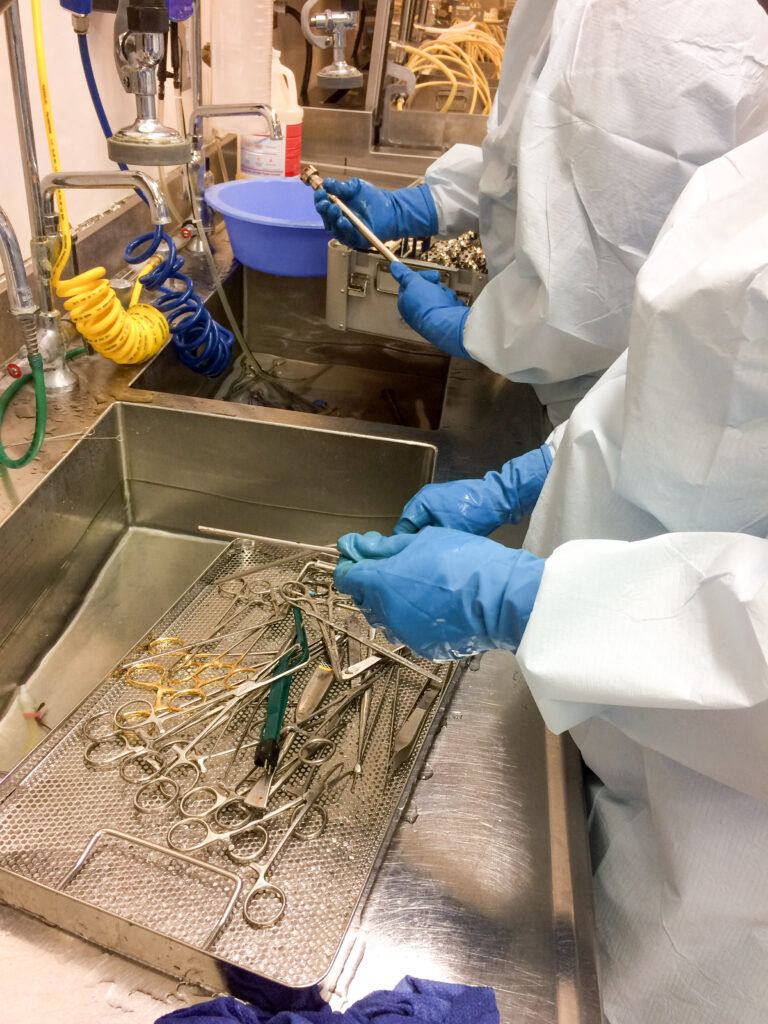 materials. The sink’s construction matters.
Laminate over particle board, or basins that aren’t fully stainless steel, are prone to water damage and create conditions where mold and bacteria can take hold, a contamination risk to staff, instruments, and ultimately patients10,11,12. The ability to not just clean, but to be cleaned, is a critical feature in a reprocessing sink12. It has to be durable enough to hold up to the process it’s built for.
It also have to be durable enough to take the frequent damage, banging and impact that comes with working with heavy surgical trays. Look under your sink, too. Plumbing and drain utilities take as much abuse as the basins. Lots of hidden costs can be incurred in these areas.
#3: “Ergonomics is a nice-to-have, not must-have.”
Both ST79:2017 (3.3.6.1.3)2 and ST91 (4.2.1)1 call for work surfaces that are height-adjustable to accommodate staff stature. Ignoring that requirement compounds over time. In a 2025 study of central sterile supply technicians, 88.3% reported musculoskeletal symptoms at the time of survey, with the lower back the most frequently affected site at 88.8%7.
A technician bending in front of a basin that’s too deep or too low doesn’t just experience discomfort. It can mean time away from work to recover, which costs facilities in workers’ compensation claims. Tools need to stay within comfortable reach to minimize strain, and a pegboard or shelving system that keeps cleaning equipment organized supports staff comfort, efficiency, and safety. Ergonomics isn’t a soft consideration in sink design. It’s a functional one.
#4: “The room provides enough light.”
Lighting is where sink design determines whether inspection is actually possible. Both ST79:2017 (3.3.5.6)2 and ST91:2021 (4.3.8)1 call for 500 to 1,000 lux at sink areas, a level room lighting alone rarely delivers. A technician standing at the basin can cast their own shadow over the work. Dirty water impedes visibility working in the basin. The sink needs overhead lighting and lighting within the basin itself to support a clear view during cleaning and inspection, plus task lighting for the fine detail work of spotting damage or residual soil before it moves along the process8.
Lighting must be a deliberate part of the equipment decision, not an assumption about the room.
Staff hurting in front of the sink creates negative impacts for people; lighting that’s insufficient lets residual soils make their way into prep and pack. The consequences are real, but so is the solution. Compliance is one goal of the instrument cleaning process9. A reprocessing sink’s design is one of the clearest levers for getting there, and the wrong sink can quietly work against every other part of a well-run department.
Curious whether your equipment is helping or hurting your process? Read our related post: Does Your Equipment Help or Hinder Your Process?
References:
- ANSI/AAMI ST91:2021, Flexible and semi-rigid endoscope processing in health care facilities. Association for the Advancement of Medical Instrumentation. https://webstore.ansi.org/standards/aami/ansiaamist912021
- ANSI/AAMI ST79:2017/(R)2022, Comprehensive guide to steam sterilization and sterility assurance in health care facilities. Association for the Advancement of Medical Instrumentation. https://webstore.ansi.org/standards/aami/ansiaamist792017
- ANSI/AAMI ST108:2023, Water for the processing of medical devices. Association for the Advancement of Medical Instrumentation. https://webstore.ansi.org/standards/aami/ansiaamist1082023
- ANSI/AAMI ST58:2024, Chemical sterilization and high-level disinfection in health care facilities. Association for the Advancement of Medical Instrumentation. https://webstore.ansi.org/standards/aami/ansiaamist582024
- ANSI/AAMI ST90:2017/(R)2024, Processing of health care products — Quality management systems for processing in health care facilities. Association for the Advancement of Medical Instrumentation. https://webstore.ansi.org/standards/aami/ansiaamist902017r2024
- Guideline Summary: Processing Flexible Endoscopes. Association of periOperative Registered Nurses. https://apic.org/Resource_/TinyMceFileManager/Implementation_Guides/10_AORNGuidelineProcessingFlexibleEndoscopes.pdf
- Chanchai W, Nacglud R, Bunnum K, et al. “Prevalence and Risk Factors of Work-Related Musculoskeletal Disorders in Central Sterile Supply Technicians, Nakhon Si Thammarat Province, Thailand.” Journal of Health Science and Medical Research. 2025;43(4):e20251146. https://doi.org/10.31584/jhsmr.20251146
- Ofstead CL, Wetzler HP, Heymann OL, Johnson EA, Eiland JE, Shaw MJ. “Longitudinal assessment of reprocessing effectiveness for colonoscopes and gastroscopes: Results of visual inspections, biochemical markers, and microbial cultures.” American Journal of Infection Control. 2017;45(2):e26–e33. https://doi.org/10.1016/j.ajic.2016.10.017
- Hu R, Yi L, Zou T, et al. “Current management status of cleaning and disinfection for gastrointestinal endoscopy: a meta-analysis.” Scientific Reports. 2024;14:27238. https://doi.org/10.1038/s41598-024-79143-2
- Centers for Disease Control and Prevention. Guidance for Reopening Healthcare Facilities After Water and Wind Damage. CDC Infection Control. https://www.cdc.gov/infection-control/hcp/reopen-health-facilities/water-wind-damage.html
- Bennett D. “Interior finishes and infection prevention.” Health Facilities Management, American Hospital Association. https://www.hfmmagazine.com/articles/3868-interior-finishes-and-infection-prevention
- Zeinali, A., & Platt, L. S. (2025). Designing for cleanability: The role of surface materials in healthcare environments. https://www.sciencedirect.com/science/article/abs/pii/S0360132325006596
- Walker JT, Bak A, Marsden G, et al. “Final rinse water quality for flexible endoscopy to minimize the risk of post-endoscopic infection: report from a Healthcare Infection Society Working Party.” Journal of Hospital Infection. 2022. https://doi.org/10.1016/j.jhin.2022.02.022
- Liu M, Zu Q, Zheng L, et al. “Investigation of microbiological non-compliance of endoscopic final rinse water associated with opportunistic premise plumbing pathogens contamination in connecting tube.” Scientific Reports. 2026;16:10783. https://doi.org/10.1038/s41598-026-46256-9
RELATED PRODUCTS
PureSteel™ Inline Sonic System

PureSteel™ EZ Gate Hinge™ Pegboard
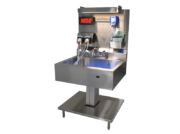
PureSteel™ Xi Reprocessing Sink