Tale of Two Realities: IFU-Compliant & Clean
◆ Key Takeaway
Following manufacturer Instructions for Use does not guarantee an instrument is actually clean, because IFUs reflect validated laboratory conditions rather than real-world workflows. Research found contamination remaining on instruments despite full IFU compliance. Departments should add verification mechanisms such as borescopes, cleaning-verification testing, and instrument-specific risk audits to confirm cleanliness beyond process compliance alone.
Like most SPD and GI departments, your staff and leadership probably have a phrase that sounds something like, “the IFU is king”, or “default to what the IFU say”. Because if your department follows every instruction in the manufacturer’s IFU to the letter, you should be able to trust the result. That’s the whole point of an IFU: a validated, repeatable process that guarantees a patient-ready device.
But these phrases need a refresh, because while IFU is king, they have their own shortcomings. These shortcomings are where leadership & staff step in, building & amending policies to focus on quality outcomes. Compliant doesn’t always mean clean.
What the Data Actually Shows
In 2025, Cori Ofstead and colleagues presented findings from a study that should make every SPD manager pause. Researchers performed 117 borescope inspections on 40 orthopedic, neurosurgical, and ENT instruments — instruments that had gone through cleaning protocols exactly as written in the manufacturer’s IFU.1
The result: every single instrument still showed evidence of contamination after cleaning. Not most. Not the majority. All of them. Rust-colored or orange patches showed up in 95% of the instruments inspected.1
This wasn’t a story about technicians cutting corners or skipping steps. IFU compliance was the starting condition of the study, not the variable being tested. The instruments failed anyway.
That distinction matters more than any single statistic in the study. It means the gap isn’t between “compliant” and “noncompliant” departments — it’s between “compliant” and “clean.” Those are supposed to be the same thing; the reality is sometimes very different.
Why This Happens
There are 4 potential reasons why IFU don’t necessarily lead to the top outcomes possible.
- They’re validation documents, not workflow documents.
An IFU describes a process that was proven effective under specific lab conditions — a specific brush, a specific soak time, a specific water temperature. It wasn’t written by watching a tech work a 20-tray case cart at 4pm who’s having a bad day before they clocked in for work. IFU rarely consider worst-case scenarios.
- IFU aren’t always accessible or practical to implement.
Ofstead’s team has separately documented IFUs that call for visual or tactile inspection of channels that are too narrow, too long, or too curved to actually see or feel into.2 Without a borescope or comparable magnification, “inspect the lumen” is an instruction with no way to actually verify it was followed. A great practical example has been the FDA’s call to inspect elevator channels at 10x magnification, a magnification level reserved for microscopes.3 Technologies may exist, but they may also be inaccessible, hard to integrate or difficult to keep care for.
- They can contradict each other.
Multi-component instruments sometimes ship with IFUs from different manufacturers that specify different chemistries, soak times, or drying methods for the same case cart, leaving techs to reconcile conflicting instructions in real time, without guidance on which one wins.
- They’re written once and rarely revisited.
An IFU reflects the instrument at time of clearance. It doesn’t necessarily update as real-world use, wear patterns, or field data reveal new failure points. That update, if it happens at all, is on the manufacturer’s timeline, not the department’s.
None of this means IFUs are worthless, but they’re the floor, not the ceiling. It means “we followed the IFU” is a compliance claim, not a quality claim.
The Fix Isn’t Abandoning IFUs, It’s Building on Top of Them
Compliance and quality are two different systems, and they need two different mechanisms.
- IFU compliance answers: did we do what the manufacturer told us to do?
- Quality assurance answers: is the outcome acceptable, regardless of what the paperwork says?
The first is necessary. The second is what protects patients and where GI and SPD leadership come in.
Risk audits are a great place to start when quality assurance measures need implementing. Risk audits take the IFU as a baseline, then ask where that baseline could still leave a gap for your specific instruments, your specific volume, and your specific staff.
A meaningful risk audit looks at things IFUs typically don’t address directly:
- Verification, not just process. Are you confirming outcomes with visual inspection, borescopes, ATP testing, or protein residue
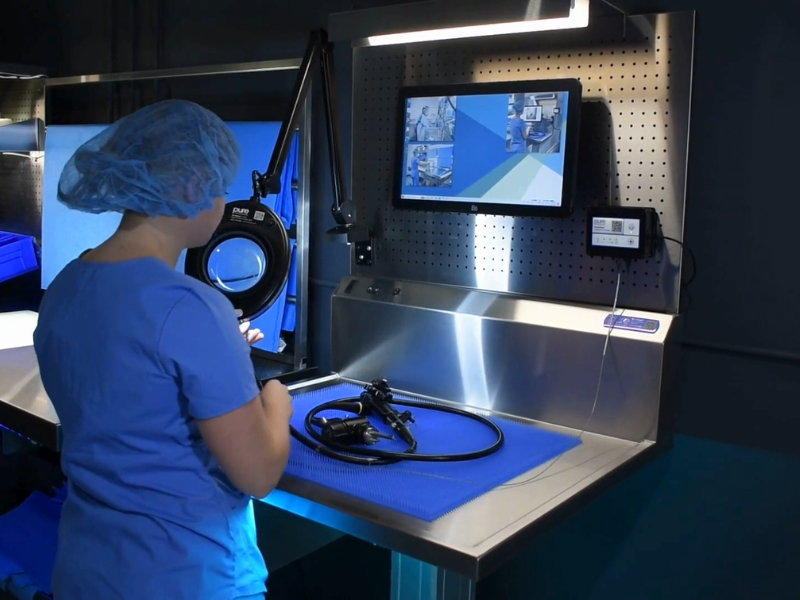 testing, or are you trusting that following the steps was enough?
 - Instrument-specific failure points. Which trays, lumens, or hinge points have a history of retained debris even when the process was followed? Ofstead’s work suggests channeled and cannulated instruments deserve extra scrutiny by default.1
- Real workflow conditions. Case volume, turnaround pressure, staff training level, and equipment condition all shape whether an IFU’s ideal process actually happens the way it reads on paper.
- Documentation of exceptions. When staff hit a contradiction, an unclear step, or an instrument that doesn’t fit the IFU as written, is that captured and escalated, or quietly worked around and forgotten?
This is audit work, and it’s ongoing work. It’s not a one-time gap analysis you file away after an accreditation visit. New instruments, new IFUs, and new staff all reset the risk.
Where to Start
You don’t need a research team to begin closing this gap; you need a structured way to look at your own process the way Ofstead’s team looked at those 40 instruments: skeptically, and with a method for checking outcomes rather than just checking boxes.
Following the IFU is the job. Verifying the outcome is what makes the job safe.
Looking to test your knowledge on quality assurance and earn .5 CE’s along the way? Read our Age of Quality Assurance CE program here, and dig deep into how you can build off endoscope IFU.
References
- Ofstead CL, Holdsworth JE, Gantt BM, et al. “Unseen Threats: Lumens 2.0 Study Reveals the Hidden Challenges of Cleaning Lumened Surgical Instruments.” Presented at the HSPA Annual Conference & Expo, Louisville, KY, April 26–29, 2025, and at the APIC Annual Conference, Phoenix, AZ, June 16–18, 2025.
- Ofstead CL, et al. “Beyond Endoscopes: Pilot Study of Surgical Instrument Lumen Inspection.” Biomedical Instrumentation & Technology / AAMI Array, 2024.
- Olympus America Inc. Urgent Field Safety Notice for TJF-Q190V, TJF-Q290V, and TJF-Q170V Duodenoscopes, October 17, 2025 (introducing 10x-magnification visual inspection of the distal tip/elevator mechanism).
RELATED PRODUCTS
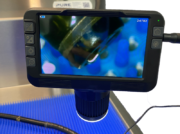
PureClear™ 10x Magnifier
PureClear™ Inspection Scopes

PureClear™ Visualization Station