Optimization Opportunities: Practical Ways to Improve Prep & Pack Workflows
◆ Key Takeaway
Sterile processing departments can improve prep and pack workflows without a full redesign by first observing how technicians actually work, then making targeted changes. Key opportunities include keeping essential tools within reach, clearing clutter from work surfaces, adding proper lighting and magnification for inspection, building in height-adjustable ergonomics, and creating dedicated setups for robotics, loaner and tray weighing workflows.
For sterile processing professionals, prep and pack is where careful, accurate work translates directly into safe patient outcomes. After decontamination, technicians inspect, assemble, organize, and prepare devices for sterilization,a critical chain of steps where every detail matters.
Yet for many sterile processing departments (SPDs), this area operates under persistent pressure. Case volumes are climbing, devices are growing more complex, and physical space is often tight. Small inefficiencies, a crowded work surface, supplies stored just out of reach, inadequate lighting during inspection, compound over the course of a shift and make it harder for technicians to perform at their best.
The encouraging reality is that meaningful optimization does not always require a full departmental redesign. Targeted improvements in organization, workflow structure, equipment selection, and ergonomics can create substantial gains in quality, safety, and technician well-being. The sections below identify the most commonly under-optimized areas in prep and pack and offer practical strategies, along with purpose-built solutions, to address each one.
Start by Watching the Workflow
Before changing anything in a prep and pack area, the most important step is observation. Watch how technicians actually move through and interact with the space during a real shift.
Ask critical questions as you observe:
- Where are they reaching across the table, bending, or walking away from the workstation to retrieve an item?
- Which supplies and tools are used most frequently, and where are they kept?
- Where does clutter accumulate, and why?
- Are there repeated workarounds that signal a deeper gap in the workflow or setup?
These everyday observations often reveal the highest-value opportunities for improvement. A well-designed prep and pack space should help technicians stay focused on the task at hand, minimize unnecessary movement, and support a consistent, repeatable process from one technician to the next.
Workflow inefficiencies are not always visible at a glance. They emerge over time as small frustrations—a heat sealer on the wrong side of the table, a reference guide stored in a drawer instead of on the wall, packaging materials that require two trips to retrieve. Identifying these moments is the starting point for any meaningful change.
PureSteel™ Specialty Impact Tables
PureSteel™ Specialty Impact Tables take the best of hundreds of consultations conducted with sterile processing departments, and combine customer feedback and ideas into workflow optimizers. The Loaner Table, for examples, combines an assembly table with integrated scale for checking in loaner trays, pegboard for mounting cameras and tracking systems, and task lights for fine inspection. Explore Specialty Impact Tables for robotics
Keep Essential Tools Within Reach
Time is lost, and focus is broken, every time a technician has to search for packaging materials, labels, inspection tools, or reference information. In a busy SPD, those interruptions add up quickly.
Frequently used items should be stored where they are easy to see, easy to reach, and easy to return. This applies to peel pouch rolls, blue wrap, heat sealer supplies, barcodes, and any device-specific reference materials. When these items are positioned within arm’s reach, technicians can maintain their focus on the work in front of them rather than the logistics of finding what they need.
Pure Processing Solution: PureSteel™ Ergonomic WorkStation
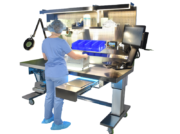
The PureSteel™ Ergonomic WorkStation is purpose-built to keep tools exactly where they are needed. Its height-adjustable pegboard system keeps packaging tools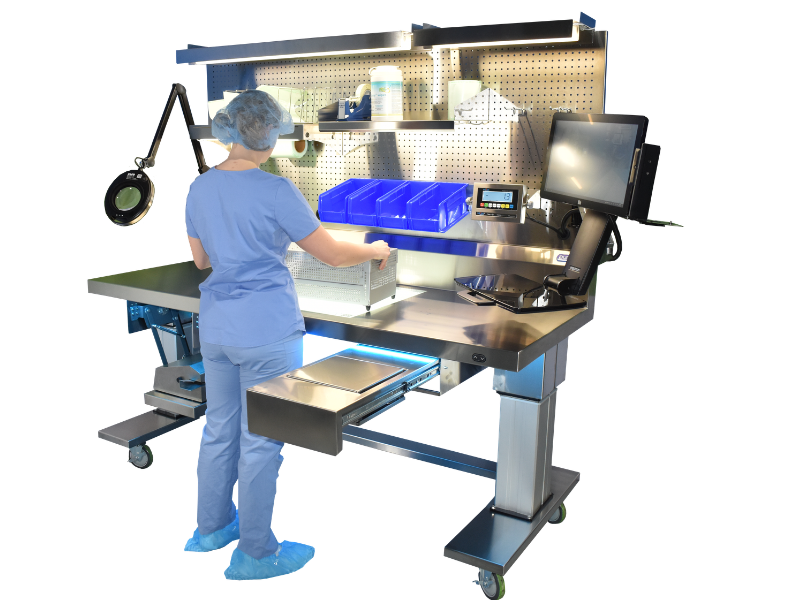 and materials visible and within arm’s reach during all prep and pack activities, without consuming counter space. Peel Pack Organization Rails, Peel Pack Pouch Shelves, Bin Rails, and monitor/scanner arms can all be configured to match the department’s specific workflow. With 8 built-in GFCI outlets and integrated cord management, equipment like heat sealers and tracking systems are powered directly from the workstation, eliminating countertop clutter.
Protect Work Surfaces from Clutter
Effective assembly work requires open, usable space. Technicians need clear room to inspect instruments, assemble trays, handle wrap, manage pouches, demagnetize instruments, and prepare sets for sterilization. When work surfaces double as storage areas, the primary task suffers.
Vertical space, in particular, is frequently underutilized. Well-designed workstations leverage back wall panels, adjustable shelving, and organized rail systems to keep supplies close and accessible without encroaching on the flat work surface where the real work happens.
Support Better Inspection
Inspection is one of the most consequential steps in the prep and pack process. Technicians must identify damage, residual debris, packaging defects, and wrap perforations before instruments are sterilized and returned to use. A missed defect at this stage does not remain contained, it moves forward.
Yet inspection is frequently under-equipped. Standard overhead lighting is often insufficient for detecting subtle instrument damage or fine perforations in blue wrap. Without proper magnification and illumination at the point of inspection, technicians are being asked to perform a highly precise task with inadequate tools.
Good lighting, appropriate magnification, and dedicated inspection space can meaningfully improve the reliability of this critical step. These enhancements also support compliance with ANSI/AAMI ST79 recommendations around visual inspection.
Pure Processing Solution: PureSteel™ Visualization Station
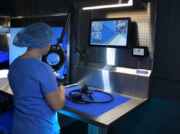
The PureSteel Visualization Station creates comprehensive quality assurance stations for key assembly tasks. Departments can centralize protein, ATP or borescope testing before instrumentation is sent to packaging for final assembly. Built-in electrical organizes tables which need multiple outlets, and pegboards get items off countertops, keeping the workspace free for inspection work. Integrate overhead lighting for improved visibility.
Pure Processing Solution: PureSteel™ Mini Inspection Table
For departments with limited floor space, the PureSteel™ Mini Inspection Table brings illuminated wrap inspection capability into a compact, mobile footprint. Its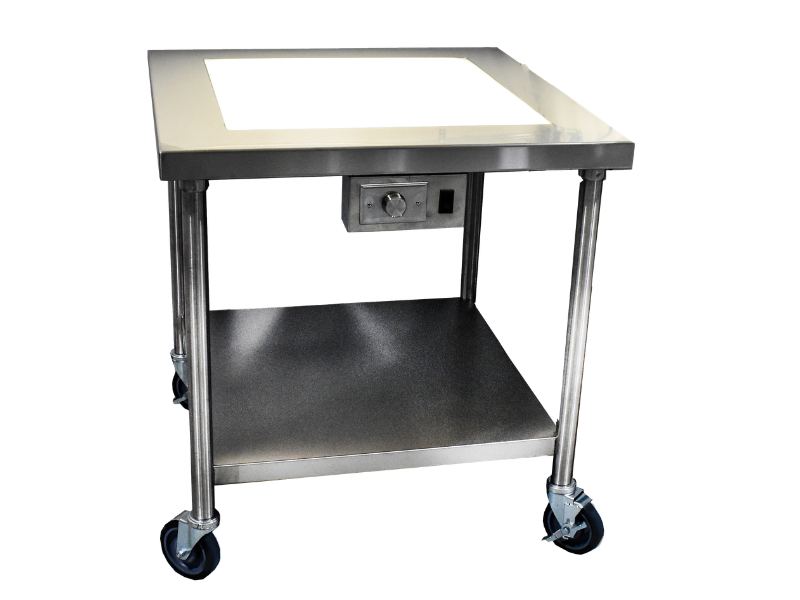 illuminated tabletop and lower storage shelf make it a practical addition to any area where space is at a premium
Build Ergonomics into the Space
Ergonomics in prep and pack is not an amenity. It is a functional requirement for departments that expect consistent, high-quality output from their teams over the course of a full shift. Height-adjustable surfaces, proper reach zones, and floor support all contribute to how long a technician can work comfortably and effectively.
Research consistently links ergonomic workplace design to reduced injury rates, lower turnover, and higher sustained performance. In an environment where workforce retention is a persistent challenge, equipping technicians with workstations that support their physical well-being is one of the most direct investments a department can make.
Pure Processing Solution: PureSteel™ Ergonomic WorkStation (Height-Adjustable)
PureSteel™ Ergonomic WorkStations are available in height-adjustable configurations, allowing technicians to raise or lower the work surface to their optimal working height, whether seated or standing. The height-adjustable pegboard rises with the table, ensuring tools remain at the most ergonomic position regardless of table height. A 3-year warranty on height-adjustment lifters reflects confidence in the system’s durability under daily use. 4
Plan for Specialty Workflows
Not every tray or device category requires the same setup. Robotic surgical instruments, loaner trays, low-temperature sterilization processes, and quality assurance testing all have distinct requirements that a generic general-assembly workstation is often not equipped to handle well.
When specialty workflows are forced into standard configurations, the result is workarounds: instruments piled in unused corners, equipment shared between technicians in inefficient ways, and compliance gaps that compound over time. Creating defined zones for specialized workflows reduces confusion, limits improvisation, and makes training significantly more straightforward.
This is also where tray weighing, demagnetization, and loaner tray management deserve dedicated attention. These tasks are frequently performed at ad hoc locations, requiring technicians to move instruments away from their primary workstation—introducing unnecessary motion and compliance risk.
Pure Processing Solution: PureSteel™ Robotics WorkStation
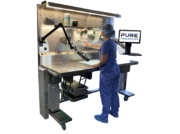
For departments managing robotic surgical instruments, the PureSteel™ Robotics WorkStation provides dedicated space for the inspection, assembly, and packaging of larger, more complex robotic devices. It features side storage sized for large robotic peel pouches, ST79-compliant overhead lighting, and 4.75x task lighting for detailed inspection. The Hughes Seal & Stow Heat Sealer Shelf keeps the primary work surface clear for instrumentation. Available in 60″, 72″, and 78″ lengths, with custom sizes available.
Pure Processing Solution: PureSteel™ Mobile Scale Cart
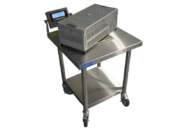
The PureSteel™ Mobile Scale Cart brings weighing compliance to wherever it is needed in the department, between packing stations, at vendor drop-off points, or wherever trays need to be verified. Rather than routing trays to a fixed scale location and disrupting assembly flow, departments can bring the scale to the work.
Small Changes Can Raise the Standard
Optimizing prep and pack is not only about moving faster. It is about creating conditions that allow technicians to work with focus, confidence, and physical comfort, shift after shift, tray after tray.
When departments reduce clutter, invest in the right inspection tools, design workstations around real workflows, and support the people doing the work ergonomically, the impact extends well beyond the assembly area. Patient safety improves. Staff retention strengthens. Compliance becomes easier to sustain.
The best place to start is always with the people already doing the work. Their daily experience of the space reveals what is working and what is not. When the environment is designed to support them, the entire department benefits.
Interested in learning how Pure Processing can help your department raise the standard? Explore the full product line at pure-processing.com or contact the team to discuss solutions tailored to your specific prep and pack workflow.
RELATED PRODUCTS
PureSteel™ Ergonomic WorkStation
PureClear™ Visualization Station
PureSteel™ Robotics WorkStation