When Pressure Builds in Decontamination
◆ Key Takeaway
When rising surgical volumes and complex instructions for use exceed a sterile processing team’s available time, tools, and capacity, pressure spreads across the entire instrument cycle. Because decontamination is the foundation for all downstream reprocessing, failures cascade; automating repetitive tasks like manual flushing recovers capacity and reduces ergonomic strain and rework.
Higher volumes and more complex instructions for use do more than make a shift feel busy. When demand exceeds the time, tools and capacity available, pressure can spread across the workflow, showing up as process variation, rework, delayed instrumentation and greater strain on the professionals responsible for protecting patients.
Reprocessing teams adapt, as they routinely do. But when temporary workarounds become part of the everyday workflow, the department can enter a cycle that is increasingly difficult to escape. Departments are often left with three unintended consequences: turnaround inefficiencies, OR delays, worker injuries.
Complex IFUs turn small steps into significant workload
The growing complexity of surgical instrumentation has increased the decisions and physical actions involved in manual cleaning. If an IFU calls for 250 mL of fluid through a lumen, a technician may need five fills with a 60 mL syringe, nine with a 30 mL syringe or 25 with a 10 mL syringe. 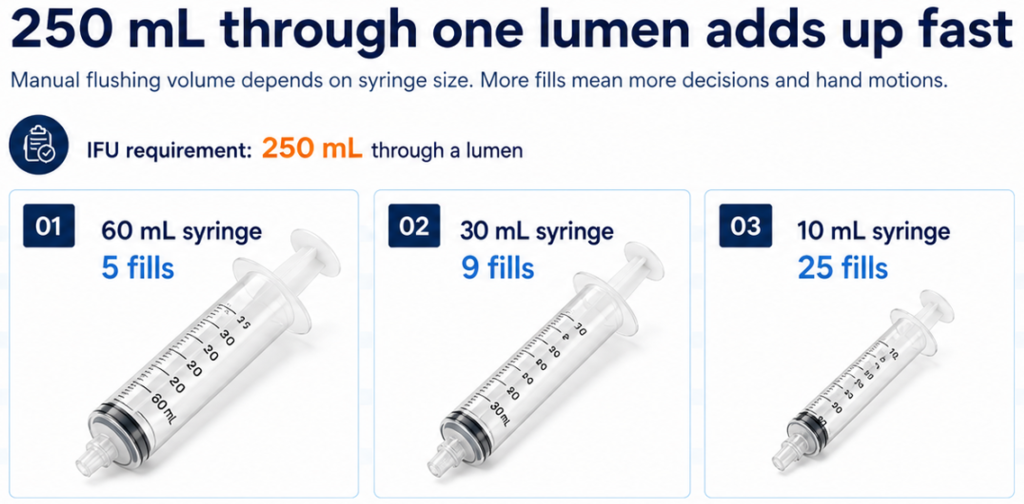
Each cycle involves filling, connecting, applying force, disconnecting and tracking the total volume delivered. Across hundreds of channeled devices and an entire shift, a small manual task becomes a meaningful source of labor, repetition and process variability.
Under pressure, steps may be performed from memory, documentation may be delayed and technicians may be interrupted before completing a sequence. These are not necessarily signs of intentional noncompliance. They are predictable responses to an overloaded process.
Rework adds pressure to an already constrained system
The 2025 Lumens 2.0 study by Ofstead & Associates illustrates why complex internal surfaces deserve particular attention. Debris, discoloration or residues were observed inside every instrument evaluated. Re-cleaning removed some material, but none of the instruments was completely free of visible findings afterward.3
When an instrument or tray requires rework, it adds delays to a workflow that is already under pressure. The instrument may need to return to decontamination, be cleaned again, reinspected, reassembled and sterilized while additional cases arrive.
This should not be read as a failure of individual technicians. It shows how internal architecture, restricted access and device clean-ability can challenge even determined teams. When departments rely heavily on manual effort, added pressure can produce more rework rather than better results.
The pressure eventually reaches the operating room
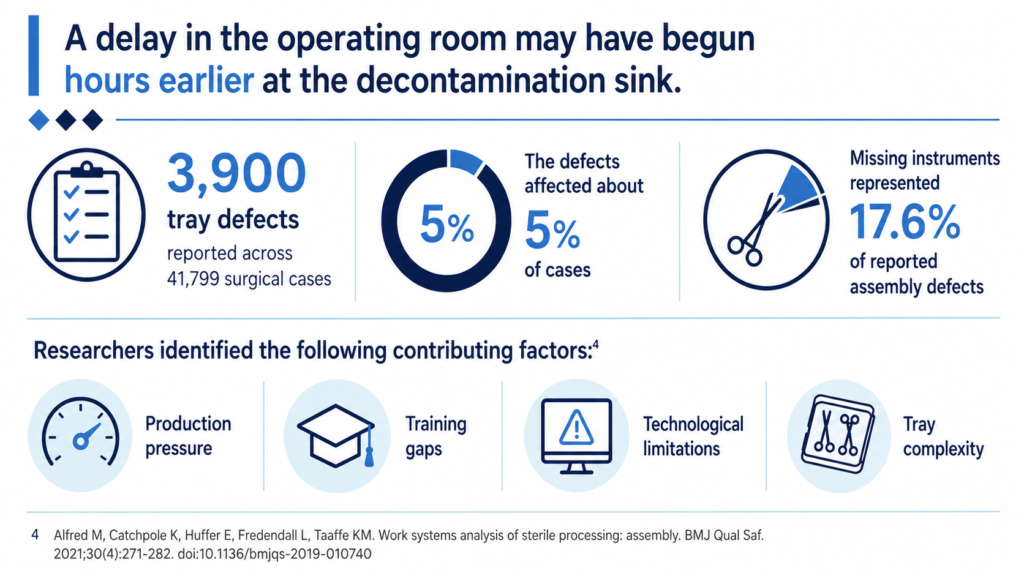
A delay in the operating room may have begun hours earlier at the decontamination sink. In one work systems study, 3,900 tray defects were reported across 41,799 surgical cases. The defects affected about 5% of cases, and missing instruments represented 17.6% of reported assembly defects. Researchers identified production pressure, training gaps, technological limitations and tray complexity among the contributing factors.4
A separate 2024 observational study recorded 236 instrument errors affecting 147 surgical cases. Nearly 89% involved visualization-dependent tasks such as instrument identification, detection of damage or bio-burden, and confirmation of correct tray contents. For cases with available delay data, more than half experienced a delay, averaging just over 10 minutes.5
These studies demonstrate that sterile processing conditions can affect downstream performance and the extent of the challenge. When decontamination falls behind, assembly receives instruments later. When trays are incomplete or unavailable, surgical teams wait.
Staff strain becomes a capacity problem
Overwhelmed teams also experience the physical consequences of repetitive work. Manual syringe flushing requires repeated forceful movements. Prolonged standing, reaching into deep basins, lifting trays and fixed postures add to the strain.
Sterile processing personnel face substantial ergonomic risk. In 2020, the U.S. Bureau of Labor Statistics recorded 1,380 cases involving days away from work among medical equipment preparers, the BLS occupational category used as the closest match for sterile processing technicians.6 These cases included 560 sprains, strains or tears,8 and resulted in a median of 13 days away from work. 6 The occupation’s rate of injuries related to overexertion and bodily reaction was 96.0 per 10,000 full-time workers, more than three times the rate of 26.2 across all occupations.9
Sterile processing-specific research has also found that 75% of participating SPD personnel experienced lower-back discomfort during the preceding year, with higher perceived workload associated with increasingly risky working postures.10
Even when discomfort does not become a formal injury, fatigue can influence pace, concentration, morale and retention. Overtime, cross-training and temporary staffing may keep the department moving, but they consume resources and can add variability.
Designing a more resilient decontamination workflow
Departments should identify the steps that create the most repetition, interruption and variation to the workflow. That may include syringe flushing, detergent dosing, instrument soaking, temperature monitoring, or instruments that require dedicated space.
The objective is not simply faster throughput. It is a more reliable system that gives technicians the tools, time and working conditions needed to execute the correct process consistently.
The financial implications extend beyond labor. A U.S. meta-analysis estimated the attributable cost of a surgical site infection at $20,785 in 2012 dollars. Not every surgical site infection is associated with instrument reprocessing, but the figure illustrates the need of investing in reliable prevention processes.7
Protecting the people who protect patients
An overwhelmed team does not need another reminder to work carefully. It needs a system designed to make careful work achievable as volumes rise, staffing changes and device complexity increases.
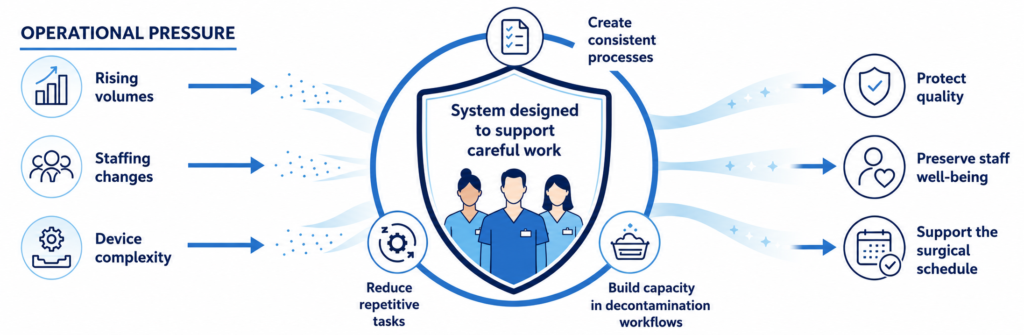
By reducing repetitive tasks, creating more consistent processes and building capacity into decontamination workflows, healthcare organizations can help prevent pressure from becoming process failure. That is how departments protect quality, preserve staff well-being and support the surgical schedule without asking teams to absorb more strain.
Ready continue improving your department? Take: Ergonomics: Its Place in Strategic Decision Making for 1CE credit!
References
- Centers for Disease Control and Prevention. Cleaning. Infection Control. Updated November 28, 2023. Accessed July 30, 2026. https://www.cdc.gov/infection-control/hcp/disinfection-sterilization/cleaning.html
- Alfred M, Catchpole K, Huffer E, Fredendall L, Taaffe KM. Work systems analysis of sterile processing: decontamination. BMJ Qual Saf. 2020;29(4):320-328. doi:10.1136/bmjqs-2019-009422.
- Ofstead CL, Smart AG, Holdsworth JE, Gantt BM, Lamb LA, Bush KM Jr. Unseen threats: Lumens 2.0 study reveals the hidden challenges of cleaning lumened surgical instruments.AmJ Infect Control. 2025;53(5):537-547. doi:10.1016/j.ajic.2025.02.003.
- Alfred M, Catchpole K, Huffer E, Fredendall L, Taaffe KM. Work systems analysis of sterile processing: assembly. BMJ Qual Saf. 2021;30(4):271-282. doi:10.1136/bmjqs-2019-010740.
- Nichol PF, Saari MJ, Navas N, et al.Observedrates of surgical instrument errors point to visualization tasks as being a critically vulnerable point in sterile processing and a significant cause of lost chargeable OR minutes. BMC Surg. 2024;24(1):110. doi:10.1186/s12893-024-02407-1.
- U.S. Bureau of Labor Statistics. “TableR66. Number of nonfatal occupational injuries and illnesses involving days away from work by occupation and number of days away from work, and median number of days away from work, private industry, 2020.”
- ZimlichmanE, Henderson D, Tamir O, et al. Health care-associated infections: a meta-analysis of costs and financial impact on the US health care system. JAMA Intern Med. 2013;173(22):2039-2046. doi:10.1001/jamainternmed.2013.9763.
- U.S. Bureau of Labor Statistics. “TableR9. Number of nonfatal occupational injuries and illnesses involving days away from work by occupation and selected natures of injury or illness, private industry, 2020.”
- U.S. Bureau of Labor Statistics. “TableR100. Incidence rates for nonfatal occupational injuries and illnesses involving days away from work per 10,000 full-time workers by occupation and selected events or exposures, private industry, 2020.”
- Nino L, Marchak F, Claudio D. “Physical and mental workload interactions in a sterile processing department.”International Journal of Industrial Ergonomics. 2020;76:102902. doi:10.1016/j.ergon.2019.102902.